
Introduction: Why Fractional CFO Pricing Matters
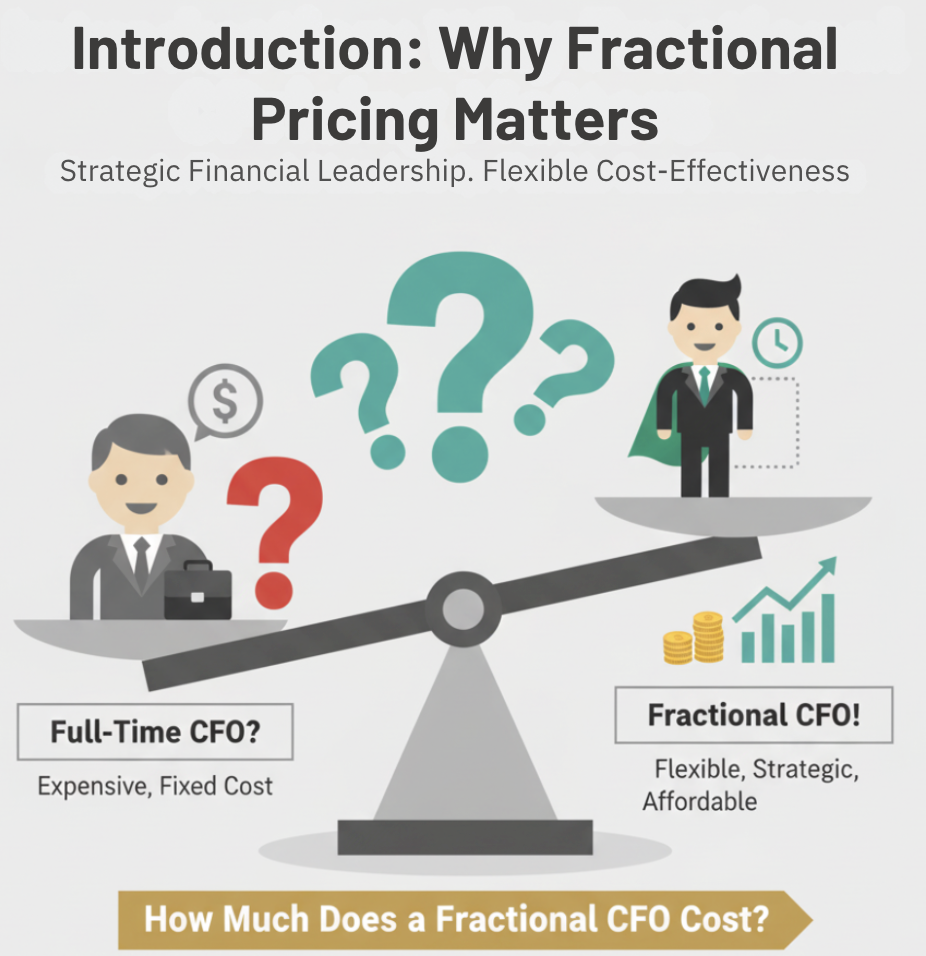
Hiring financial leadership is one of the most strategic decisions a business can make. But here’s the challenge: many founders and business owners don’t need (or can’t afford) a full-time CFO. That’s where a fractional CFO comes in — offering high-level financial expertise on a flexible, cost-effective basis.
Still, one of the first questions business leaders ask is: “How much does a fractional CFO cost?” Understanding pricing benchmarks not only helps with budgeting but also with selecting the right structure for your company’s growth stage.
In this guide, we’ll break down the best fractional CFO pricing examples — from hourly rates to monthly retainers — and give you a clear view of what to expect.
Typical Fractional CFO Pricing Models
Fractional CFOs usually work under a few common pricing structures. Each has its pros and cons depending on your company’s size, complexity, and financial needs.
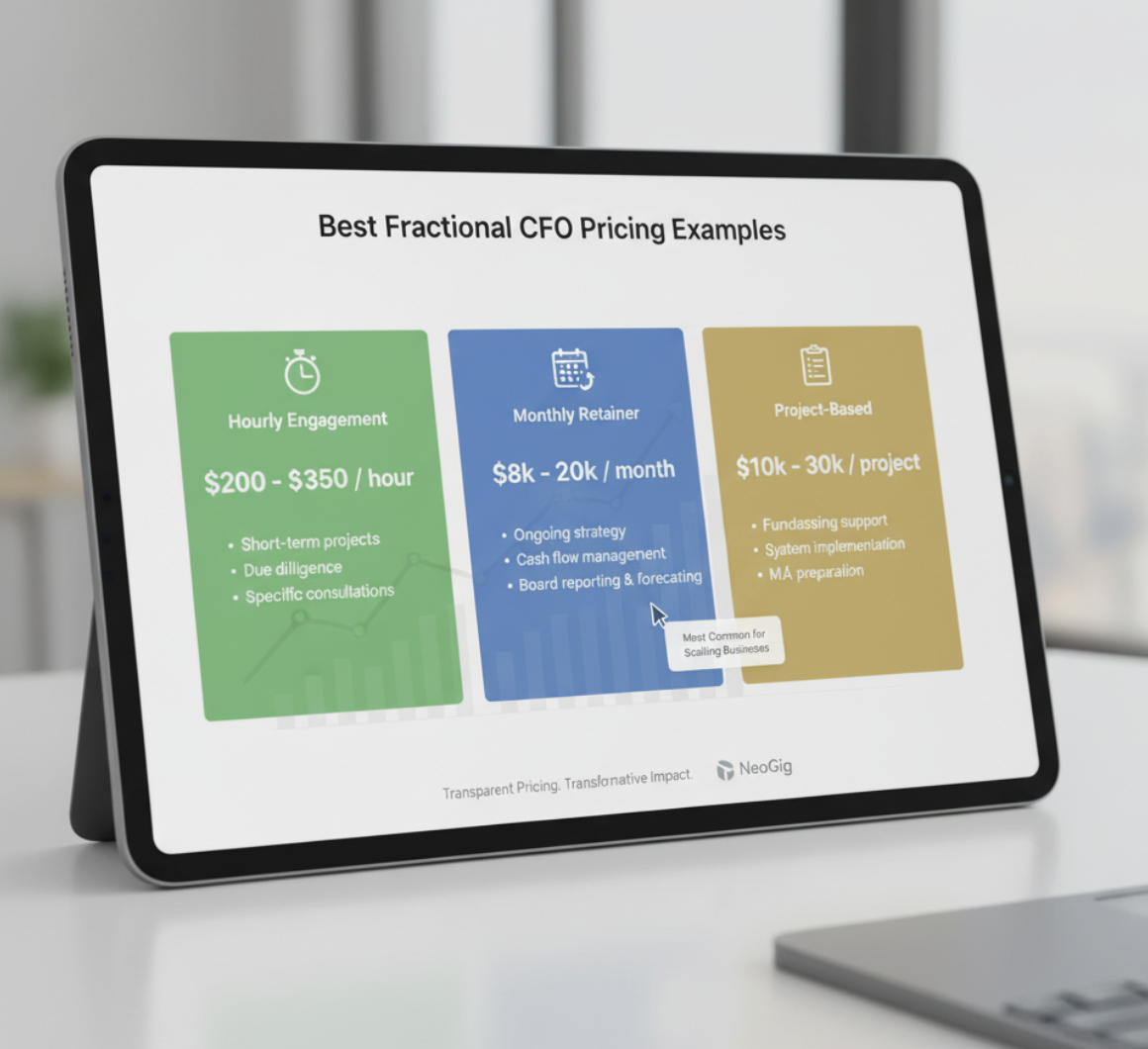
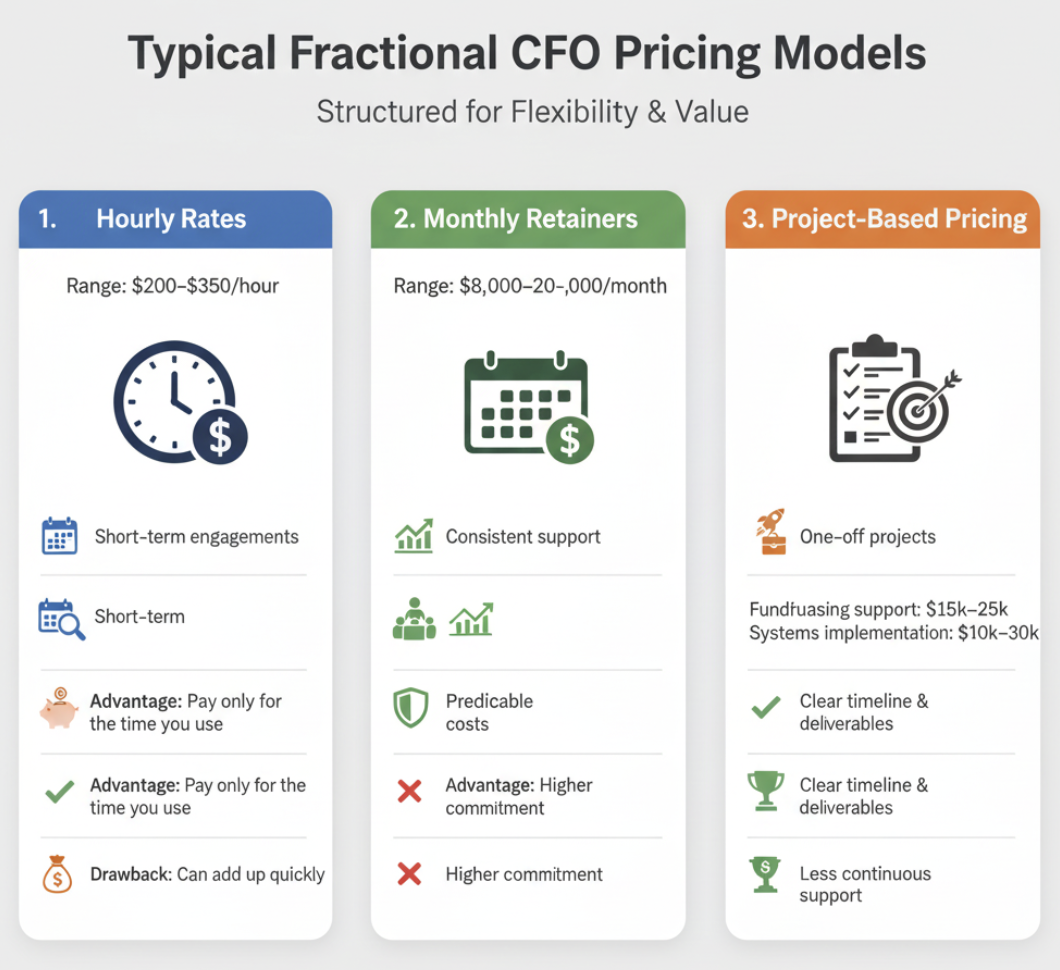
1. Hourly Rates
- Range: $200–$350/hour
- Best for: Short-term engagements, project-based needs (e.g., fundraising prep, due diligence).
- Advantage: Pay only for the time you use.
- Drawback: Can add up quickly if your needs are ongoing.
2. Monthly Retainers
- Range: $8,000–$20,000/month
- Best for: Businesses needing consistent support, such as board reporting, cash flow forecasting, or M&A prep.
- Advantage: Predictable costs and deeper engagement.
- Drawback: Higher upfront commitment than hourly pricing.
3. Project-Based Pricing
- Examples:
- Fundraising support: $15,000–$25,000/project
- Financial systems implementation: $10,000–$30,000/project
- Best for: One-off projects with a clear timeline and deliverables.
Factors That Influence Fractional CFO Pricing
Not all engagements are equal. Pricing depends on several factors:
- Company size & complexity – Larger businesses with multiple entities, international operations, or complex compliance needs require more time and expertise.
- Engagement scope – Are you asking for financial strategy only, or hands-on reporting, fundraising, and operations support?
- Industry specialization – CFOs with experience in regulated or high-growth industries (like healthcare or SaaS) often command higher rates.
- Level of involvement – Fractional CFOs may attend weekly leadership meetings, lead investor discussions, or simply provide monthly reporting.
Real-World Examples of Fractional CFO Pricing
Here’s a snapshot of what businesses are paying today:
| Engagement Type | Typical Price |
|---|---|
| Startup fundraising readiness | $12,000/project |
| SaaS company, $5M ARR | $10,000–$15,000/month |
| Manufacturing firm (multi-entity) | $18,000–$20,000/month |
| Hourly, short-term consulting | $250–$300/hour |
These benchmarks help set expectations, but remember: the best fractional CFO pricing comes down to value alignment, not just cost.
How to Decide What’s Right for You
When evaluating pricing models, ask yourself:
- Do we need ongoing strategic finance leadership or just short-term project help?
- What’s the ROI of having a CFO? (e.g., raising capital faster, avoiding costly tax mistakes, improving cash flow visibility)
- Does this engagement align with our growth stage and budget?
💡 Pro Tip: Use resources like a 90-day success checklist to map your financial priorities before hiring.
Leveraging AI & Tools to Optimize Fractional CFO Engagements
Fractional CFOs are increasingly using AI-driven tools to streamline forecasting, scenario modeling, and reporting. For example:
- AI-powered prompt libraries for financial analysis (see resource)
- Automated reporting workflows that save time and reduce errors
- Playbooks for M&A readiness and due diligence (see business playbook)
At NeoGig, we encourage leaders to explore these resources — including EJ Bowen’s free AI advantage ebook — to better integrate CFO support with smart, future-proof processes.
FAQs: Fractional CFO Pricing
1. What’s the difference between a fractional CFO and a full-time CFO?
A fractional CFO works part-time or project-based, typically at a lower cost, while providing the same strategic financial expertise as a full-time CFO.
2. Is it better to pay hourly or monthly for a fractional CFO?
If you need limited, specific help, hourly works best. For ongoing leadership, a monthly retainer provides stability and deeper integration.
3. Do fractional CFOs work with startups?
Yes. In fact, startups often rely on fractional CFOs for fundraising, cash flow modeling, and financial system setup without committing to full-time costs.
4. How do I know if I’m overpaying for a fractional CFO?
Compare against benchmarks ($200–350/hr or $8k–20k/month). If pricing is above these ranges, it should come with proven expertise, industry specialization, or added scope.
5. Can AI tools reduce the cost of fractional CFO services?
Yes. By leveraging AI-driven forecasting, reporting, and analysis, CFOs can deliver faster insights, often reducing overall engagement hours.
Final Thoughts: Choosing the Best Fractional CFO Pricing
The best fractional CFO pricing isn’t about finding the cheapest option. It’s about securing the right financial leader who can deliver measurable impact, whether that’s securing funding, improving cash flow, or guiding M&A strategy.
👉 If your business is ready to explore fractional executive leadership, NeoGig can connect you with vetted CFOs and other leaders who bring clarity, stability, and expertise — without the full-time overhead.